Welcome to the first installment of our IGNITE Series. This series will explore what high-quality service-learning and civic engagement look like in practice, why youth voice and leadership matter, and how we can create meaningful opportunities for young people to lead change in their communities. Together, we’ll explore how IGNITE can help move the field from good intentions to meaningful, lasting impact.
Before You Take Action, Start With a Question
Meaningful service-learning doesn’t begin with an activity, a volunteer opportunity, or even a community need. It begins with curiosity. It begins when we take the time to ask questions, look inward, and discover what matters enough to act on.
Often we want to jump straight to service. We see a problem in our school or community, recognize an unmet need, and immediately start thinking about what we can do to help. We organize a food drive, plan a cleanup, launch a fundraiser, or recruit volunteers. Our intentions are good, and our desire to make a difference is real.
But what if we started somewhere else? What if, before deciding what to do, we took time to ask why the issue matters, whose voices need to be heard, and what we have to contribute?
That’s where Inquiry begins, and it’s the starting point of nylc’s IGNITE Service-Learning Cycle.
Start with what matters to you
Inquiry is more than identifying a problem or choosing a community issue. It begins with ourselves and our teams.
What do we value? What experiences have shaped our perspectives? What makes us curious, concerned, hopeful, or even frustrated about the world around us? What issues do we find ourselves returning to again and again?
These questions matter because meaningful community engagement is often rooted in a personal stake in a public problem.
When young people can connect deeply to an issue affecting their community, the work becomes more than an assignment or an opportunity to earn service hours. It becomes their “why” of the experience. It ignites their voice and their want to take action.
And this is where educators, youth workers, and community leaders have an important role. Rather than telling young people which problems matter or what projects they should undertake, we can create the spaces for youth voices to flourish. Where they can explore their interests, share their perspectives, and identify the issues they want to address.
We don’t need to have all the answers. We need to ask better questions.
Inquiry changes how we approach community problems
Too often, service begins with an activity rather than an understanding of the issue. We decide to collect supplies, serve meals, or clean up a neighborhood without first exploring the underlying conditions that created the need.
Inquiry challenges us to slow down. To listen. To learn.
It encourages young people to dig deeper into the underlying issues of the problem. It invites them to examine assumptions, listen to people with lived experience, and recognize that the perspectives we bring to a challenge may not be the only perspectives that matter.
Perhaps your young people are interested in addressing food insecurity. Rather than immediately organizing a food drive, inquiry can help them ask:
- Why does this issue matter to me? To my neighbors?
- Why do some families in our community experience food insecurity?
- What barriers prevent people from accessing affordable, nutritious food?
- Who is already working to address this issue?
- What do people experiencing food insecurity say they need?
- What do we know, and what do we still need to learn?
- What could young people contribute to addressing this challenge?
When young people explore these questions, it can lead to a very different understanding of the issue and, ultimately, a more meaningful response.
Inquiry helps move us from doing something for a community to working with a community.
You don’t have to know where you’re going to get started
One of the biggest barriers to getting started with service-learning is the belief that we need a fully developed project, a clear plan, or even a solution before we begin.
We don’t. In fact, not knowing the answer is a perfectly good place to start.
Inquiry is about embracing curiosity, being willing to learn, and recognizing that meaningful solutions emerge through exploration and collaboration. It gives young people permission to ask difficult questions, challenge assumptions, and discover opportunities they might not have otherwise considered.
For educators and youth-serving professionals, getting started can be as simple as dedicating time for a conversation:
- What is something happening in our community that you wish you could change?
- What makes you care about it?
- Who is most affected?
- Whose perspectives are missing from the conversation?
- What would you like to understand better?
Let the questions lead. Resist the temptation to rush toward a project or solution. Give young people the opportunity to discover what matters to them and why.
That is where ownership begins. It shouldn’t be rushed or ignored. In a meaningful service-learning experience, inquiry is the foundation for learning and impact.
IGNITE: Turning curiosity into meaningful action
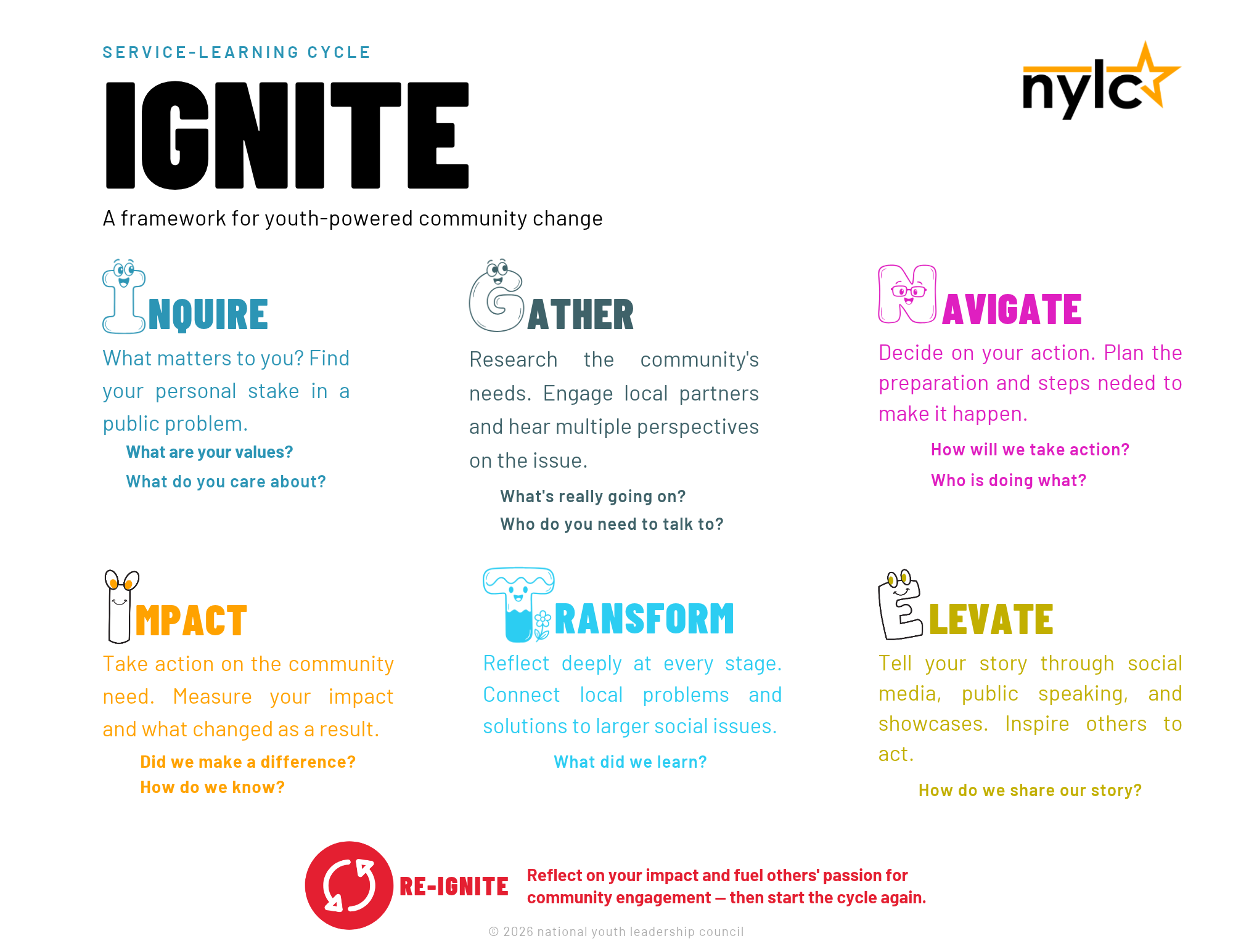
Inquiry is the first step in nylc’s IGNITE Service-Learning Cycle and helps you move through eight interconnected elements:
- Inquire: Explore personal and team values to identify a personal stake in a public problem.
- Gather: Learn about community needs, engage local partners, and consider multiple perspectives.
- Navigate: Make deliberate decisions and prepare and plan for action.
- Impact: Take action on the community need and measure the impact.
- Transform: Reflect deeply throughout the process, connecting local problems and solutions to larger social issues.
- Elevate: Share the work and its impact through storytelling, public speaking, social media, and other platforms.
- Re-IGNITE: Reflect on the impact and fuel others’ passion for community engagement.
Each element builds on the others, creating an experience that connects learning, action, reflection, and continued engagement.
Our challenge to you is simple. Before planning the next service project, organizing the next volunteer opportunity, or deciding what your young people will do to make a difference, try something different.
Start with a question.
Ask what matters to young people. Ask what they notice. Ask what they want to understand. Ask whose voices need to be included. You might be surprised where those questions lead.
Because meaningful service-learning doesn’t start with having the answers. It starts with being willing to ask the questions. And that’s how we IGNITE change.