By Amy Meuers, CEO, national youth leadership council
There is something powerful about gathering with people from around the world who believe deeply in the same idea: young people can learn by serving, and they can change the world while they do it.
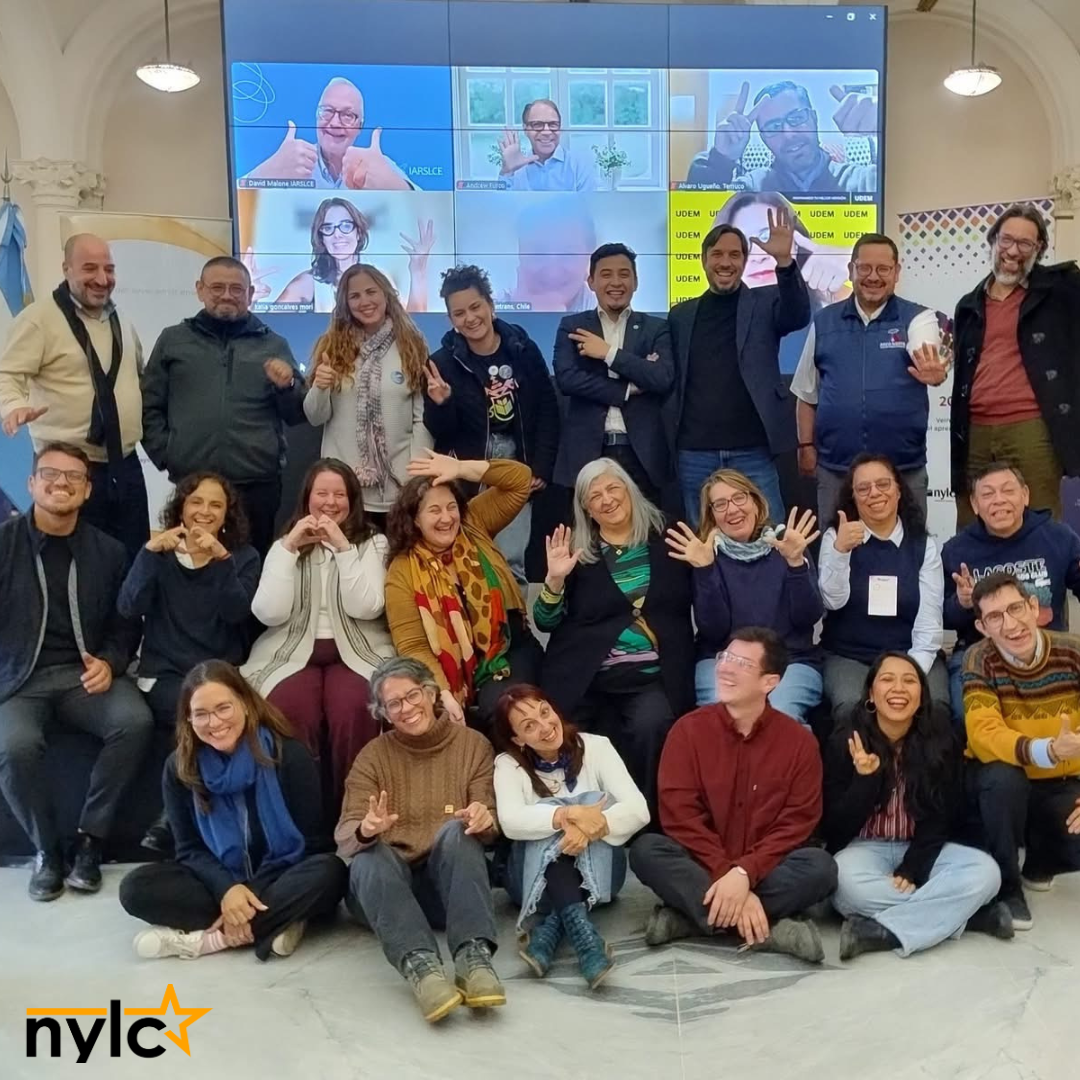
That was the spirit I experienced in Buenos Aires, Argentina, during the country’s Service-Learning Week, where I had the privilege of participating in the 29th International Solidarity Service-Learning Conference and the 20th anniversary meeting of the Red Iberoamericana de Aprendizaje Servicio, or REDIBAS.
For me, the experience was both an opportunity to share what we are learning at nylc and a reminder that the service-learning movement is much bigger than any one country, organization, or educational system. It is a global movement.
A Global Movement Rooted in Local Communities
The International Solidarity Service-Learning Conference brought together educators, researchers, students, community leaders, and practitioners from across Latin America and beyond. What struck me most was how differently service-learning can look depending on the context, while the fundamental principles remain remarkably consistent.
Whether the work is happening in Argentina, Mexico, Chile, Uruguay, Ecuador, Spain, the United States, or elsewhere, service-learning begins with a similar premise: education becomes more powerful when young people connect what they are learning to the real needs and possibilities of their communities.
Throughout the conference, I heard examples of educators creating opportunities for students to engage with issues ranging from social inclusion and education to environmental challenges, democratic participation, and community development.
These are not simply academic exercises. They are opportunities for young people to see themselves as capable of contributing to something larger than themselves. That is at the heart of why service-learning matters.
Bringing the U.S. Perspective to an International Conversation
I was honored to present on “Service-Learning in the Development of Competencies for Democratic Citizenship and the New World of Work.” My presentation focused on an idea that I believe is increasingly important: the skills young people need to be effective citizens are deeply connected to the skills they need to navigate the world of work.
Through nylc’s new IGNITE Service-Learning Cycle, we are intentionally designing service-learning experiences that develop both. Young people begin by identifying their own values and finding a personal stake in a public issue. They gather information and perspectives, navigate decisions and competing viewpoints, take meaningful action, reflect on what they have learned, and elevate their experiences through storytelling and advocacy. Along the way, they are developing civic agency, critical thinking, empathy, collaboration, creativity, communication, project management, adaptability, leadership, and problem-solving.
These are not separate skill sets. They are human capacities that young people need everywhere.
Our work with the Freudenberg Stiftung Foundation through the Service-Learning in Civic Education, or SLICE, initiative is exploring this connection more deeply. Through our U.S.-Germany collaboration, we are examining how service-learning and civic education can strengthen democratic participation while also developing the knowledge and skills young people need to thrive.
Being in Buenos Aires reinforced for me that this conversation is not uniquely American. Educators everywhere are asking similar questions:
- How do we help young people feel connected to their communities?
- How do we give them meaningful opportunities to exercise agency?
- How do we prepare them to navigate disagreement without retreating into polarization?
- And how do we ensure that education prepares young people not only to understand the world, but to have the confidence and skills to shape it?
Celebrating 20 Years of REDIBAS
One of the most meaningful parts of the week was co-facilitating the meeting of REDIBAS, which celebrated its 20th anniversary.
The meeting took place in the White Hall of Argentina’s Secretariat of Education, bringing together representatives of service-learning networks from across the Ibero-American world, both in person and virtually.
Twenty years is an extraordinary milestone. But what stood out to me was not simply the history of the network. It was the sense of possibility about its future. Representatives shared developments from national and regional networks in Mexico, Chile, Uruguay, Spain, Ecuador, Argentina, and the United States. Each network has its own context, challenges, and opportunities, but all are working to strengthen service-learning through training, research, institutional partnerships, policy, and community engagement.
There was also a strong emphasis on what comes next: strengthening communication, building new partnerships, connecting researchers, sharing knowledge, and creating greater visibility for service-learning internationally. That conversation reminded me that movements survive when we intentionally invest in the people and relationships that sustain them.
Learning Across Borders
Another exciting conversation in Buenos Aires focused on strengthening connections among international networks, researchers, and organizations. There was discussion about potential collaborations as well as opportunities to strengthen research, share knowledge, connect journals, and develop a broader research agenda for service-learning.
This is the kind of collaboration I believe our field needs more of.
We have tremendous knowledge across countries and regions, but too often that knowledge remains within individual networks or national systems. Imagine what becomes possible when we connect those experiences. A successful service-learning practice developed in Argentina might inspire a teacher in Minnesota. A research finding from the United States might inform work in Spain. A youth leadership model from Chile might spark an idea in Ecuador. The challenges we face are global, but the solutions are often deeply local. International networks allow us to learn from one another while honoring the contexts in which that learning takes place.
What I Brought Home
I left Buenos Aires energized, but also reflective. The week reinforced several things for me.
First, service-learning is fundamentally about agency. When young people have meaningful opportunities to investigate issues, make decisions, take action, and reflect on their experiences, they begin to see themselves differently. They move from being recipients of education to being contributors to their communities.
Second, democracy is strengthened through practice. We cannot simply teach young people about democratic values. We have to give them opportunities to practice listening, deliberating, collaborating, navigating differences, making decisions, taking responsibility, and working with others toward a shared goal.
Third, the competencies of citizenship and the competencies of the workplace are deeply interconnected. Collaboration, communication, creativity, adaptability, critical thinking, leadership, and problem-solving are essential whether a young person is working on a community issue, participating in a democracy, or entering the workforce.
And finally, none of us can do this work alone.
The relationships built through networks like REDIBAS remind us that movements are strengthened through connection. We need educators learning from educators. Researchers learning from practitioners. Organizations sharing resources. And, most importantly, we need young people helping to shape what comes next.
Looking Toward Minneapolis
As I returned home, I found myself thinking about our own National Service-Learning Conference, which will take place in Minneapolis, Minnesota, March 22-24, 2027. The conversations in Buenos Aires made me even more excited about bringing the global service-learning community together again.
I hope nylc’s 2027 conference can be a place where we not only celebrate what our field has accomplished, but also ask what it will take to build the next generation of service-learning. What does service-learning need to look like in a changing world? How do we put youth voice and youth leadership at the center? How do we strengthen the connection between civic engagement, democratic participation, career readiness, and purpose? How do we ensure that young people are not simply participants in our movement, but co-creators of its future? Those are questions worth exploring together. Because my time in Buenos Aires reminded me that while our languages, cultures, educational systems, and communities may be different, we share something incredibly important:
We believe in the power of young people to learn, lead, serve, and create change. And that is a movement worth carrying forward. Leadership starts here. And it starts with young people.